
Your flight touches down at Phoenix Sky Harbor, the seatbelt sign clicks off, and the cabin fills with that first-day-of-a-trip shuffle. You have your bag, you have your phone, and you still have roughly 145 miles of Arizona between the terminal and Flagstaff. The desert outside the window is warm and flat. Where you are actually going sits at about 7,000 feet, up in the ponderosa pines, and it can be a very different temperature by the time you get there.
That gap, between the airport you land at and the mountain town you want to reach, is the whole reason a Sky Harbor to Flagstaff shuttle exists. Below is how the process works from the moment you book to the moment you are standing at your own front door, a hotel lobby, or a residence hall at Northern Arizona University.
Book Before You Fly, Not After You Land
The single thing that makes the trip smooth happens before you ever board your outbound flight: you reserve the ride ahead of time. A private transfer is scheduled around your specific flight, not a fixed timetable you have to catch. When you book, you hand over three basics: your arrival date, your flight number, and the Flagstaff address you are heading to. That flight number matters more than most travelers expect, and the terminal pickup section explains why.
Booking ahead also settles the vehicle. A solo traveler with a carry-on and a couple up for a weekend fit a sedan; a family with ski bags or a group of six coming in on one flight needs an SUV or a van. Matching the vehicle to your party in advance is what keeps you from standing at the curb, realizing the luggage will not fit.
What to Have Ready When You Book
- Your flight number and airline, so the driver can track the arrival
- Your landing date and the local time you are scheduled to touch down
- The exact Flagstaff drop-off address (home, hotel, or campus building)
- Your head count and a rough luggage picture (checked bags, ski or golf gear, car seats)
- A phone number you will actually answer at baggage claim
Finding Your Driver at the Terminal
This is the part first-time riders worry about, and it is the part a private service is built to make painless. Sky Harbor is a busy airport with three terminals and a lot of moving parts, so a good transfer uses a meet-and-greet: your driver is already there, usually near baggage claim, holding your name, rather than leaving you to hunt for a car in a crowded pickup lane.
Flight tracking is the quiet piece that makes the meet-and-greet actually work. Because you gave your flight number when you booked, the driver watches your flight in real time. Land forty minutes early, and the driver knows. If weather back at your connection pushed things two hours late, the driver knows that too and shifts the pickup instead of leaving you stranded or running a meter. You are not paying for the time you spent sitting on a taxiway.
Once you find each other, the driver takes the bags. Luggage goes into the vehicle, you settle into a clean sedan, SUV, or van, and the next time you think about those bags is when they come back out at the other end. Cold water and a phone charger are usually within reach, which is a small mercy after a long day of gates and layovers.
The Drive North: About 145 Miles Up I-17
Now the trip itself. From Sky Harbor, the route runs north on Interstate 17, the main artery linking the Phoenix basin to the high country. It covers roughly 145 miles and usually takes about two to two and a half hours, depending on how thick traffic is leaving the metro and what conditions look like on the climb.
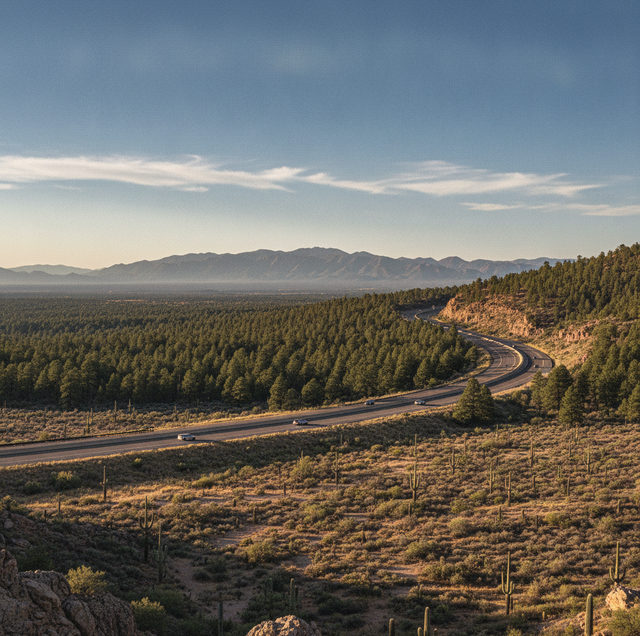
And it is a climb. Phoenix sits on the desert floor at around 1,100 feet. Flagstaff sits near 7,000 feet, at the base of the San Francisco Peaks. Over the length of I-17, you gain close to 6,000 feet, and the country outside the window changes with you: saguaro and creosote give way to high-desert scrub, then juniper, then the tall ponderosa pine forest that rings Flagstaff. The temperature usually falls the whole way up. It is common to be shirt-sleeve warm at the Phoenix curb and jacket-cool stepping out at the top, in any season, which is exactly why locals travel this road in layers.
The weather on I-17 cuts both ways, and it is worth knowing before you decide to drive it yourself. In the warmer months, afternoon monsoon storms can roll over the Rim and drop sudden, heavy rain that flattens visibility on the interstate. In the colder months, that same grade can carry snow and ice near Flagstaff while Phoenix stays dry and mild. A driver who runs this corridor daily reads those conditions and paces the drive to match, which is a different experience from meeting an unfamiliar mountain highway in a rental car you picked up an hour ago.
Where the Shuttle Actually Drops You
Door-to-door is the phrase that sets a private transfer apart from most other options, and it is meant literally. The big shared shuttles and buses drop everyone at a single depot or transit stop, and from there, the last leg is your problem, usually a second ride to wherever you are really staying. A private transfer skips that handoff. It takes you to the specific address you gave when you booked.
For most travelers, that means a home driveway or a hotel entrance. For a lot of Flagstaff arrivals, it means Northern Arizona University: parents helping a student move in, or a student flying back after a break, set down right at the residence hall or campus address instead of at a curb across town with a semester of luggage and no easy way to cover the last two miles. The same goes for a rental cabin in the pines, a trailhead lodge, or a stop in the Verde Valley on the way up.
Private Transfer, Driving Yourself, or the Big Shuttle
How does this stack up against the alternatives? Driving yourself means a rental counter after a long flight, then two-plus hours on an unfamiliar mountain interstate, then parking, insurance, and fuel, plus the same drive in reverse when you leave. You do get a car for the whole stay, which is worth a lot if your plans spread across the region. It is worth much less if you are headed to a walkable downtown, a campus, or a resort where the car mostly sits in a lot.
A big scheduled shuttle or bus runs on a fixed timetable between set points. You catch a departure that may not line up with your flight, you ride with a full load of strangers, and you get off at a depot rather than your door. If your flight lands late, the schedule does not wait for you.
A private transfer trades that fixed timetable for a ride built around your flight and your address. It is the option that protects your time and removes the most guesswork: someone is tracking your arrival, meeting you inside the terminal, handling your bags, driving a road they know cold, and stopping at your real destination. For late-night landings, groups, families hauling gear, or anyone who simply does not want to drive I-17 after a full travel day, that tends to be the deciding factor.
Frequently Asked Questions
A late arrival is normal for this route, since red-eyes and delayed connections both dump travelers into Sky Harbor well after the terminals quiet down. Around-the-clock service means a 1 a.m. landing is handled the same as a noon one. The practical tip is to flag a very late or very early pickup when you book, so the driver plans the overnight run specifically rather than treating it as a daytime slot. Your flight number still drives the timing, so a red-eye that lands early gets met early.
Reserve as soon as your flights are ticketed. Vehicles, especially the larger vans, get spoken for first during the busy stretches: NAU move-in and graduation weekends, the winter holidays, fall color season on the Rim, and ski weekends when Snowbowl is running. During those windows, a few days is cutting it close for a six-seat van. A quiet midweek arrival gives you more room, but early booking locks in the right-sized vehicle to your exact flight.
Yes, and it helps to provide the specific building or campus address rather than just "NAU," since the university spans a large campus with several residence halls and separate lots. On move-in weekends, sharing a van with another arriving student or family can put several people and their boxes on one trip instead of two. If you are the one flying home, the same address serves as your pickup point for the return trip to Sky Harbor.
The drive still runs, but timing gets a buffer. When snow is on the grade near Flagstaff, a local driver builds in extra minutes and paces the climb rather than pushing a schedule, and an SUV or all-wheel-drive vehicle handles the conditions better than a low sedan. If you are connecting to a flight out of Phoenix on a snowy morning, give the pickup a wider cushion than you would in summer, because the same storm that dusts Flagstaff can slow the whole corridor.
Usually, yes, within the seating and cargo limits of a van. The tradeoff to plan for is gear: a full van of passengers plus ski bags, golf clubs, or a stack of checked luggage can use up the space that would otherwise seat another person. Give an honest head count and luggage list when you book so the right vehicle shows up, rather than discovering at the curb that the group needs to split across two cars.
One-way is fine, whether that is only the airport-to-Flagstaff leg on arrival or only the Flagstaff-to-airport leg when you fly out. For the return to Sky Harbor, plan the pickup earlier than the drive time alone suggests: you want margin for the roughly two-and-a-half-hour trip plus check-in and security at a large airport, and a snowy or stormy morning on I-17 eats into that cushion fast.
Planning the Ride That Fits Your Trip
The Sky Harbor to Flagstaff run is short enough to feel routine and long enough that the details matter: a real elevation change, a mountain interstate with its own weather, and a last mile that ends at your actual door instead of a depot. Booking a private transfer ahead of time turns all of that into someone else's job while you look out the window and watch the desert turn into pines. Give the flight number, name the drop-off, and the rest of the process is built to meet you where you land.
Book your Sky Harbor to Flagstaff transfer before you fly, share your flight number, and step off the plane to a driver who is already tracking your arrival. Western Express Shuttle Service and Tours serves Sedona, Flagstaff, Phoenix Sky Harbor, and northern Arizona's Verde Valley and Rim Country. Call (928) 202-4071.
