
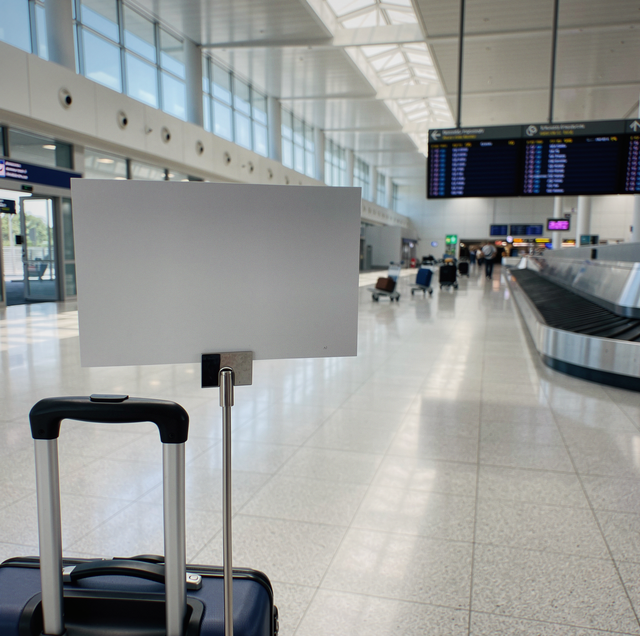
The jet bridge door opens, and a hundred strangers funnel into a terminal that means nothing to most of them. Signs point toward baggage claim one way and ground transportation another, a departures board scrolls flight numbers nobody has time to read, and your phone is still catching up to a new time zone. Somewhere in that building is the person who is supposed to drive you, and right now neither of you can see the other.
A meet-and-greet pickup closes that last gap from the driver's side. Wherever a given airport allows a person without a boarding pass to wait for arriving passengers, at an arrivals door, a baggage claim exit, sometimes a ground transportation hall, your driver is already standing there holding your name and carrying your bags from that spot out to the vehicle. What makes it work is smaller than the idea sounds: the name on the sign, the flight number the driver is watching, the spot you were both given, and what each of you does in the minutes when you miss each other.
What You Bring to the Meeting and What the Driver Brings
Three things belong on your phone before the wheels touch down: your confirmation details, the driver's name and a direct number that reaches that driver rather than a general line, and a description of the meeting spot specific enough to walk to, a named door, a particular baggage claim exit, a landmark that sits in one fixed place. Screenshot all three; a terminal is a poor place to hunt through an inbox.
The driver holds a matching set. Your name, spelled the way you gave it at booking. The flight number you are arriving on, watched through a live status feed instead of the printed arrival time, so the meeting time moves with the aircraft. That gap is what a waiting allowance is built around, and how long the allowance runs is set by the operator. And the terminal that flight number lands at, which turns a status update into a place to stand.
Both halves have to name the same spot, and this is where an otherwise fine plan comes apart. Baggage claim means one thing at a terminal with two carousels and something vaguer at one with ten. A door with a number on it gives two people who have never met the same picture of where to be.
None of this makes curbside pickup the wrong choice for every trip. Curbside pickup is the right call for a frequent flier with a carry-on who already knows the terminal, not the traveler working out an unfamiliar airport for the first time.
The Name on the Sign Is the Only Identifier Either Side Has
A driver in an arrivals area runs a match in two directions at once. One is the flight: passengers off a single arrival come through in a recognizable wave, so the driver knows when to start watching and when that wave has thinned out. The other is your name, the only thing separating you from everyone else in that wave.
That match works only if the name on the sign is the one your eye is scanning for. A legal first name you have not used since school, a surname that changed after the booking was made, a spelling transliterated one way on the itinerary and another way in your head: each of those prints a sign you read as somebody else's and walk past. Give the operator the name you will recognize at a glance, and where it differs from the name on the booking, ask for both on the sign so the two records still line up.
Format matters less than spelling. A printed card and a tablet display read at about the same distance across a crowded hall; what changes the outcome is whether the characters match the ones you are looking for.
A Codeshare Points the Tracking at the Wrong Flight
One airline sells the seat and a different carrier operates the plane. Your itinerary prints the marketing flight number, the one belonging to the airline you booked through, while the aircraft itself flies and reports under the operating carrier's number. Both numbers are real. Only one of them is attached to the plane you are sitting in.
Live flight tracking follows the operating number, because that is what the aircraft broadcasts and what a status feed keys on. Hand a driver only the marketing number, and the tracking either follows a different aircraft or returns nothing at all, and the first symptom is a driver standing at the right door at the wrong time.
If your booking shows one airline but boards under another, send the operator both flight numbers. Live tracking uses the carrier's flight number, which is often different from the one printed on your itinerary.
The same mismatch can move you across the airport. A regional carrier operating the flight may work out of a different terminal than the airline whose name is on your booking, which changes the meeting point and timing.
Each Airport Decides How Close a Driver Can Get
Many airports restrict who may pass a security checkpoint without a boarding pass, which is why a meeting point usually sits on the public side of one: an arrivals door, a baggage claim exit, a ground transportation hall. Which of those applies to your arrival depends on that airport's rules and how the terminal is built, so the operator confirms the exact spot for your terminal before the trip rather than assuming the last airport's arrangement carries over.
Terminal geometry does the rest. A concourse connected to arrivals by an internal train puts several minutes of walking between the gate and the meeting point, and it puts a decision in front of you, whether to follow signs for baggage claim or for ground transportation, that a first-time arrival cannot answer. Naming the spot in the confirmation settles that before you are standing under the sign that points to it.
A terminal change deserves a message as soon as you know. A driver holding a name at one terminal's arrivals door cannot cover another at the same time, and a rebooking or an aircraft swap can move your arrival across the airport without changing the itinerary in your hand.
What Happens When You Walk Past the Sign
Plenty of arriving passengers walk straight past a sign carrying their own name. Eyes are on a phone that has just reconnected, or on the monitor listing carousel assignments, and the sign sits at chest height in a crowd all moving one direction. A driver working arrivals expects this, which is why the sign is only the first step of the identification and the two phone numbers are the second.
The recovery runs on those numbers. The driver watches for your flight's passengers coming through, and when that wave thins out without you in it, texts or calls the number on file. From your side, the move is the same one reversed: call the driver's direct number instead of walking the hall looking. A driver at an agreed spot is a fixed point, a passenger circling the hall is a moving one, and two people searching take far longer to find each other than one searching and one standing still.
Two smaller things make the last few feet easier. Some operators have drivers wear a shirt or badge indicating they work the arrivals area, which lets you confirm that the person holding your name belongs there. And if you have stepped outside, say so, because a driver holding a sign inside has no view of the curb.
An International Arrival Moves the Meeting Point Past Customs
On an international arrival, a driver has no way to reach you until immigration and customs processing finishes, so the meeting point sits past that exit. That much is easy to name: the processing hall has a controlled exit, often a single one, and everybody on your flight comes through it.
The timing is the hard part, and the reason is structural. A flight feed ends at the gate. Everything after it happens, where no tracker can see: the walk, the queue at immigration, the wait for a bag at terminals that put the carousel inside the hall, and a second checkpoint where arrivals are routed through one. How long that runs depends on how many wide-body arrivals cleared into the same hall in the same hour, so two flights landing five minutes apart can put their passengers out forty minutes apart.
That spread also changes what a driver can read from the doorway. Passengers off one international flight emerge over a long stretch rather than in a single wave, so an empty exit says nothing about whether you are still in the queue. An international pickup leans harder on the direct number for that reason: a message sent the moment you clear the exit is the one thing that tells a driver the hall is behind you.
Frequently Asked Questions
Whether anyone without a boarding pass can reach a gate area depends on that airport's own security rules, and many keep non-travelers on the public side of the checkpoint, which puts the meeting point at the nearest arrivals door or baggage claim exit. The operator confirms what your airport allows before you fly. Ask again if one trip routes you through two airports, since the arrangement on the way in may not describe the one on the way home.
This is the case for a named meeting spot. A spot agreed in writing before departure still works on a dead phone, because you can walk to a numbered door without calling anyone, while one that was going to be settled by text after landing cannot. Write the door or carousel down somewhere other than on your phone, and tell the operator if you expect to land without a number, so the driver can hold the spot rather than call it in.
Your confirmation includes the driver's name and a direct number, both of which are checkable on the spot: the name on the sign should match the one you were sent, and calling that number should reach the person in that person's hand. Anyone who cannot produce your booking reference has not been assigned to you, and one call to the operator's line settles it.
The airline's own procedure for releasing a minor to an approved adult by name happens at the gate, as its own separate step. A driver's role begins once that release is complete, and you have cleared into the terminal, so the two run in sequence. Give the operator the name of the adult the airline has on file, since that is the person the driver expects at the sign.
Not on all of them. Where customs is cleared depends on how the itinerary is routed rather than on the final airport, and some routings clear it at the first airport of entry, leaving the last leg to land in an ordinary domestic arrivals area. That moves where the driver stands, so confirm it whenever an international leg is followed by a domestic one.
No. A family or group arriving together on a single flight is covered by one driver holding one name at one meeting point, the same as a solo traveler, and one confirmation with one flight number tells the driver who is arriving and when. The detail worth passing on is the luggage count, since the assigned vehicle has to hold it, and that is settled before the driver leaves.
Book a meet-and-greet pickup and skip the guesswork at arrivals — a driver already positioned inside, holding your name, tracking your actual flight. Western Express Shuttle Service and Tours serves Sedona, Flagstaff, Phoenix Sky Harbor, and northern Arizona's Verde Valley and Rim Country. Call (928) 202-4071.