
East of Flagstaff, Interstate 40 strings together three very different stops: an impact crater blown into the desert floor, a historic railroad town that grew up along the old Route 66 corridor, and a national park built around fossilized logs and layered badlands. None of the three sits close enough to walk between, and each one asks for its own turn at the wheel, its own parking, and its own set of directions. A single driver who stays with the vehicle all day folds those three setups into one. No one in the group has to drive the return leg tired, the stops line up on the group's own timing instead of someone else's schedule, and a day that could easily fall apart into three separate errands instead moves as one trip.
Each of the three stops asks something different of the day; here is what a visitor does at each one, how much of the day it draws, and what is worth having on hand for it.
| Stop | What You Do There | How Much of the Day | What to Have With You |
|---|---|---|---|
| Meteor Crater | View the impact site from the lookout decks behind the visitor center, then take in the exhibits | A short stop | A hat, sunscreen, and a light jacket for wind at the lookout decks |
| Winslow | Walk the historic downtown and its Route 66 and railroad-era buildings | A short stop | Closed-toe shoes for uneven sidewalks and curbs |
| Petrified Forest National Park | Drive the park road between its two entrances, stopping at overlooks over the badlands and the fossilized logs | The longest stop of the day | Water, sun protection, and closed-toe shoes for the short walks |
The Crater Stop
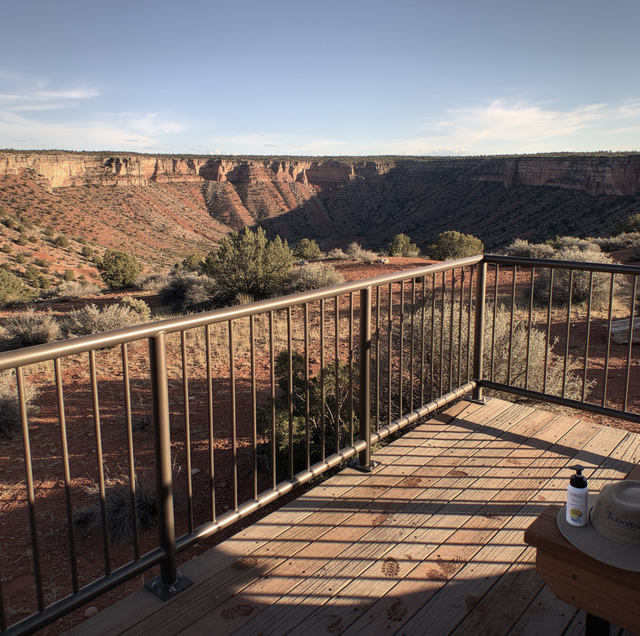
The crater itself is a bowl blown into the high desert by an impact, and the visit is built around looking down into it from above. Railed lookout decks behind the visitor center let a visitor look down into the bowl and out across the rise of ejected rock around its edge, and the visitor center features exhibits on impact events and the site's own history. It is a privately owned attraction rather than part of the national park, so it has its own admission and rules, separate from any park pass used later in the day at Petrified Forest. A guided walk along the rim is the only way onto it beyond the decks, and it gives a narrated view of the bowl from the rim itself. The floor of the bowl sits below the level of the surrounding plain, while the raised rim of broken rock is what shows first on the approach, so the full depth only opens up from the decks. The object that dug it was an iron-nickel meteorite, and the blast peeled the bedrock layers up and folded them back over on themselves along the edge; that uplift, capped by rock thrown out of the bowl, raises the rim above the plain. Because the stop centers on the decks and the exhibits in one place, with no network of trails to cover, it fits into a short window without cutting the visit short.
Winslow and Its Route 66 and Railroad History
Winslow grew up where the railroad crossed the desert, and its downtown still carries that layered history in its buildings. The historic Route 66 alignment runs directly through town on its own street, separate from the interstate that now carries the through traffic, and a walk along it passes older storefronts and a restored early-20th-century railway hotel that once served travelers along the same rail line. The rail line itself still runs beside downtown, so the railroad half of the town's story sits in plain view of the street, next to the highway half. The stop works as a walking break in the middle of a driving day: a chance to get out of the vehicle, cover the downtown on foot, and take in a piece of the corridor's history before the drive continues east toward the park. Because the buildings sit close together along a short stretch of street, the stop covers a lot of ground without asking for much time.
Petrified Forest and the Park Drive Between Its Entrances
Petrified Forest National Park is built around a single road that runs the length of the park between its two entrances, so a day visit here centers on driving that corridor and stopping at the overlooks that face it. The park's name comes from the fossilized logs scattered across its badlands, wood turned to solid stone over an immense stretch of time. The logs were buried in sediment rich in volcanic ash; groundwater carried silica into the buried wood, replacing it with quartz, and traces of iron and other minerals left the reds, yellows, and purples in the stone. The drive passes several places where the logs sit exposed on the surface within view of a short walk from the parking area. The same road also crosses layered, colorful hills built from exposed bands of ancient sediment, a different kind of terrain from the fossil wood that gives the park its name, and a reminder that the park is two kinds of country joined by one road. Because that road runs the park's entire length and calls for several separate stops along it, this leg takes the longest of the three, and it is worth planning the rest of the day around that fact rather than the other two stops.
Every piece of petrified wood in the park stays where it lies, from a large log down to a fingernail-sized chip, and carrying any of it out of the park is prohibited.
Planning the Order and the Turnaround
The order of the three stops follows from which one takes the longest. Starting the day early gives the group more room to work with, since a later start compresses time at the stop that already takes the longest of the three. Which end of the park to enter from depends on the direction the day is already moving: heading out from Flagstaff in the morning favors starting at the end nearest that approach and finishing at the far end, so the group is pointed the right way for the return leg instead of backtracking across the same stretch of road twice. The south entrance sits on a highway that leads back to the interstate, so a visit entered from the north end can leave from the south end and still rejoin the interstate for the ride home. The return leg is timed to coincide with when the park stop wraps up. A short break between the crater and Winslow gives the group a chance to stretch before the longest stop of the day, and a little slack there protects the time set aside for the park.
What to Bring for a High-Desert Day
All three stops sit in open, high desert country, and the same short list of gear covers them all. Water comes first, since the dry air pulls moisture out of a body faster than it feels at the time, especially while walking between overlooks with little shade nearby. A layer worth adding or shedding covers the swing between a cool morning start and a hot midday stretch, since the day's temperature range can be wide even when the forecast looks mild. Sun protection, meaning a hat and sunscreen at minimum, covers the crater's lookout decks and the park overlooks where there is little natural cover. Closed-toe shoes with real tread handle the loose, uneven ground on the park's short walks out to the fossil beds, as well as the curbs and sidewalks downtown in Winslow. Sunglasses belong on that list too, for the glare off pale rock at the overlooks.
Crumbling badland slopes and unrailed drop-offs beyond the marked trails and overlooks can give way underfoot, and sun and drying wind on exposed paths can bring on heat illness; when winter conditions change on the interstate, the service makes the road-safety call.
Frequently Asked Questions
No. The first lookout deck sits directly behind the visitor center, a short walk from the parking area, and the bowl is also visible from inside the visitor center.
Yes. The park road crosses the old Route 66 alignment, and a historic inn near the north entrance, once a stop for travelers on that road, now serves as a visitor center with exhibits.
It depends on the stop. At the park, a leashed pet can go on the trails and overlooks but not into the buildings; at the crater, pets stay out of the viewing areas and buildings, and the site keeps a shaded pet area outside instead.
Still active. It remains a stop on a passenger rail line, so the platform can have a train easing through while visitors are downtown on foot.
Yes. The crater has a café in its visitor building, the park has a restaurant at its north complex and snacks at its south museum, with restrooms at both, and Winslow has restaurants downtown.
Yes. The spur roads leading to both the Meteor Crater visitor area and the Petrified Forest entrances are paved from the interstate all the way in, so none of the three stops require unpaved or high-clearance driving to reach them.
Book a custom private tour of Meteor Crater, Winslow, and Petrified Forest — one driver, one vehicle, with stops timed to the group's own day. Western Express Shuttle Service and Tours serves Sedona, Flagstaff, Phoenix Sky Harbor, and northern Arizona's Verde Valley and Rim Country. Call (928) 202-4071.