
Can an Airport Shuttle Fit a Large Family with Luggage?
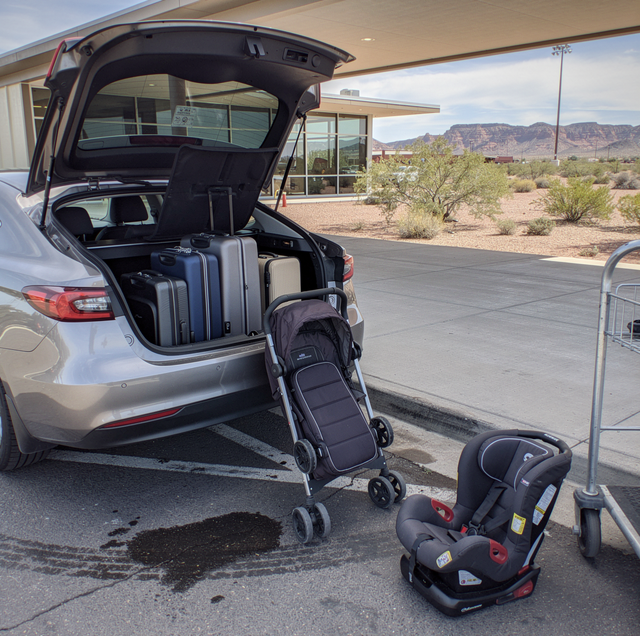
The curb outside Sky Harbor is already loud when your family's flight lands, and the carousel has just handed back four checked bags, a folded stroller, two hard-sided car seats, and a cooler someone swore you would need for the drive up to Sedona. You count six people, count the bags twice, and eye the shuttle idling at the curb the way you might size up a suitcase you know is too small to zip.
That scene is not really about how many seats a vehicle has. It comes down to whether the vehicle waiting at the curb was ever sized for the people and everything they packed for two weeks across northern Arizona's high country, and whether you said so at booking.
When the Trunk Won't Close on Pickup Day
Ask any family who has flown into Phoenix Sky Harbor or Flagstaff Pulliam with more than four people and you know the shape of the problem. Airline math counts seats and calls it done, but a family of six or eight does not travel light: car seats, a stroller, a cooler for the drive to the Verde Valley, and the duffel every teenager insists on packing separately. None of that fits inside the trunk a standard sedan was built around.
The symptom shows up at the worst moment: at the curb, after the flight, when everyone is tired, and the vehicle sent for you is already there. A trunk that won't close, a lap full of backpacks, a folded stroller wedged in sideways, none of that is a rare mishap. It is the predictable result of matching a family's real load against a vehicle never asked what that load would be.
Nobody notices the mismatch while packing at home. The suitcases go in one at a time, the car seats fold up small, and it all feels manageable in a bedroom with the floor as extra space. The curb has none. Everything the family owns for the trip has to fit in one vehicle, on one load, in the ten minutes before the drive to Sedona or Flagstaff starts.
Why a Sedan or Small SUV Runs Out of Room First
A sedan trunk is built around a couple of roller bags and not much else, so a family of five or six with checked luggage is often over capacity before anyone climbs in. The seats can hold the people, but the cargo area cannot hold what they brought, and something ends up on a lap or left behind. Add a third row to a small SUV, and the seats improve, yet the cargo well behind that row often shrinks to almost nothing, right where the suitcases were supposed to go.
The honest constraint is not the passenger count on a rental listing. It is the volume behind the last row of seats, measured in cubic feet, not headcount, and that number rarely comes up until bags are piling up on the sidewalk. A vehicle rated for seven can still really be the wrong choice for a family of five with luggage, because seats and cargo are two separate budgets, and one almost always runs out first.
What Swells a Family's Luggage Past What You Packed For?
A family's luggage count rarely matches what anyone actually planned in the driveway at home. Car seats and booster seats add bulk that a packing list never accounts for, and each one takes up roughly the space of a full suitcase once it is out of the trunk and standing on its own. A stroller folds down small in a photo and takes up an entire cargo shelf in real life. Northern Arizona's own layered climate adds another round: the desert floor near Phoenix sits around 1,100 feet, while Flagstaff climbs to roughly 7,000 feet, so a family dressing for both ends of the trip packs warm layers and cool ones in the same bags, not one season's worth of clothes.
Group size compounds the problem; it does not just add to it. Two travelers with two suitcases make a contained load. Six travelers each bringing a suitcase plus a personal item are not simply six times that load, because shared items- a cooler, towels, bottled water- pile on top of the individual bags.
By the time everyone is standing at the curb, the pile in front of a large family is often two or three times what a single traveler would have checked, and that swelling, not the traveler count, is what catches a vehicle by surprise.
How Seats and Cargo Space Trade Off Inside One Vehicle
Every passenger vehicle trades people for cargo, and moving the split one way moves it away from the other. Fold a third-row bench flat for suitcases, and a family loses two or three seats it needed for people. Leave the row up for everyone to ride, and the cargo well behind it shrinks to a shelf barely wide enough for backpacks.
A dedicated passenger van avoids that trade because its footprint was drawn around both categories from the start, not split from one interior after the fact. The rest depends on who rides along: a shared run sells seats to several parties, so its cargo bay is split with strangers and capped per seat, while a private booking hands one family all of it.
What a Full-Size Van Changes About the Fit
A full-size van changes the math because it was drawn around both jobs from the start, seating and cargo, instead of stretching a sedan's frame to cover a job it was never built for. The interior provides a large family with real bench seating without stealing space behind it, so the suitcases, car seats, and cooler all have a place that isn't somebody's lap. Loading also changes: a rear or side cargo door built for suitcases beats digging through a sedan's trunk lid one bag at a time while the family waits.
The difference shows up most clearly on the drive itself, not just at loading. A van climbing from the desert floor near Phoenix up the Mogollon Rim toward Flagstaff carries a family and its full luggage load without anyone rearranging bags at a rest stop halfway up I-17. A driver who runs that climb regularly and helps load the vehicle at the curb turns what could be a fifteen-minute puzzle at Sky Harbor into a load that goes in once, in the right order, and stays there for the whole trip.
None of that means every family needs the largest vehicle available. A couple with two suitcases is well served by a sedan, and a family of four with modest luggage often fits comfortably in a mid-size SUV. The point is not to default to the largest option out of caution; it is to match the vehicle to the actual load, not to a guess based on headcount alone.
Booking a Shuttle That Already Knows Your Head Count
The fix is not complicated, but it only works before the flight lands, not at the curb. Tell dispatch the real numbers when you book: how many people, how many car seats, and roughly how many checked bags to expect. That single conversation lets a company send a van, not a sedan, before anyone is standing outside baggage claim with a growing pile of bags and no plan. A driver who knows what is coming can plan the loading itself, so nothing shifts on the climb toward Sedona or Flagstaff.
The failure mode worth naming plainly is not that a large family cannot travel by shuttle. It is a vehicle arriving already full before anyone opens the trunk, sized for a headcount nobody double-checked against the actual pile of bags, car seats, and coolers waiting at the curb. That gap between the reservation and the real load, not the family's size, is what turns an ordinary airport pickup into a scramble.
Frequently Asked Questions
It depends more on the vehicle than your family size, not just the headcount. Dispatch also asks for a bag count because a van built for larger groups carries one full bag per traveler. Give an honest count when you book so the right vehicle meets you.
Yes, and it helps to mention them separately from your general bag count. A car seat or booster takes up roughly as much space as a full suitcase once it is out of the trunk. Tell dispatch how many you're bringing, and say if you want help installing one, so your space is planned ahead.
A good driver works it at the curb, repacking the cargo area or shifting a bag to your lap. That is a fallback, not the goal: an accurate count when you booked is meant to prevent that scramble. If your load has grown since booking, a call lets dispatch send you a larger vehicle before your flight lands.
Sometimes, but the third row usually decides it, not the total seat count. Many large SUVs seat seven only by folding the cargo area down to almost nothing behind the last row, leaving no room for suitcases, car seats, or a cooler. A van with cargo space behind the full seating is the safer choice when your whole family also carries real luggage.
Book as soon as your travel dates are set. That gives dispatch the most room to match the right vehicle to your group, especially heading into Sedona's or the Grand Canyon's busier seasons when larger vans are in higher demand. Even short notice works, but confirm your group size, luggage count, and any car seats a few days ahead, not left to guesswork at the last minute.
It is possible, but splitting your family across two vehicles usually means two arrival times, two drivers, and two chances for something to go sideways on a long drive to Sedona or Flagstaff, not one group traveling and arriving together. A single van sized to your real headcount and luggage keeps everyone on one schedule and skips a second pickup point. If your group is large enough that even a van feels tight, say so when you book, so dispatch can plan two vehicles on purpose rather than split your family into two rides as an afterthought at the curb.
Traveling with a large family and a season's worth of luggage — book one shuttle sized to carry the whole group and every bag, with a driver who helps load it at the curb for the airport ride. Western Express Shuttle Service and Tours serves Sedona, Flagstaff, Phoenix Sky Harbor, and northern Arizona's Verde Valley and Rim Country. Call (928) 202-4071.
