
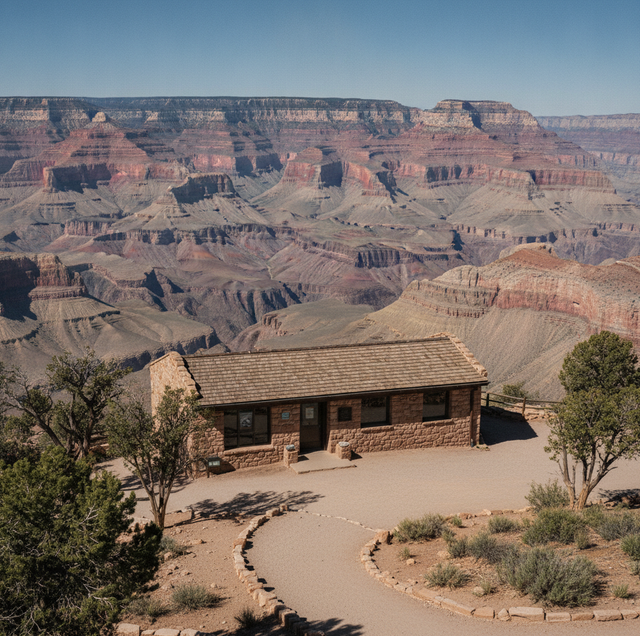
You have booked the Grand Canyon trip, your flight lands at Phoenix Sky Harbor, and now the logistics hit you. The South Rim sits roughly 230 miles north of the airport, about three and a half to four hours of driving each way, and you have no interest in picking up a rental car, learning an unfamiliar highway, and steering an SUV up into the high country after a long flight. The good news is that plenty of people reach the canyon every day without ever touching a rental. The question is which option fits your group, your schedule, and how much of the day you want to spend thinking about the road.
This is a real gap between two destinations that do not share an easy connection. Phoenix is a sprawling desert metro; the Grand Canyon's South Rim is a small park village at the edge of a very big hole in the ground, with the nearest towns an hour away. Nothing about the trip is a quick hop, so the smart move is to pick your ground transportation on purpose rather than default to a rental counter because it is the first thing past baggage claim.
What the Trip From Phoenix to the Canyon Actually Involves
Before you compare options, it helps to picture the route, because the drive shapes every choice below. From Sky Harbor, you head north on Interstate 17, climbing out of the Phoenix basin at about 1,100 feet of elevation and up onto the Colorado Plateau. By the time you reach Flagstaff, you are near 7,000 feet, and the South Rim itself sits close to that same height. That is a serious elevation gain packed into a couple of hours, and it means the weather and temperature at your drop-off can look nothing like the weather you left at the airport.
Two towns act as the gateways. Flagstaff, on I-17 and I-40, is the largest and has the most connecting services. Williams, a little west of Flagstaff on I-40, calls itself the gateway to the Grand Canyon and is the departure point for the train. From either town, the final stretch runs north on Highway 64 to the park's South Entrance near Tusayan and on into Grand Canyon Village. Total driving distance from the airport is around 230 miles, depending on the exact route, and the honest door-to-door time is closer to four hours once you factor in a stop.
Almost everyone means the South Rim when they say Grand Canyon. It is open year-round, holds the visitor center, the historic village, and the main viewpoints, and it is the rim these routes serve. Keep that in mind as you read on, because a couple of the alternatives you will see online actually point to different parts of the canyon.
Your Realistic Options Without a Rental
There are five common ways to make the trip carless, and they trade off in predictable ways: how many transfers you deal with, how much luggage you can bring, how flexible the timing is, and whether you get a guide or just a ride. Here is the shape of each before the detail.
| Option | How it works | Transfers | Best for |
|---|---|---|---|
| Private car service | One chauffeured vehicle door to door, airport or hotel to the rim, on your schedule | None | Families, groups, and anyone wanting flexible timing and luggage room |
| Shared scheduled shuttle | A van running set departures, usually with a change of vehicle in Flagstaff | One or more | Solo travelers and pairs are comfortable with a fixed timetable |
| Bus plus connecting shuttle | Intercity bus to Flagstaff or Williams, then a separate shuttle to the rim | Two or more | Travelers with light bags and an unhurried, flexible day |
| Grand Canyon Railway | Reach Williams first, then ride the historic train up to the South Rim | Depends on how you get to Williams | Travelers who want the ride itself to be the experience |
| Guided day tour | A driver-guide takes a group on a round-trip in a single long day | None, but a fixed group pace | Visitors on a tight trip who want narration and no planning |
The two ends of that table are worth separating clearly. A private transfer and a guided tour both put you in a professional's vehicle with no transfers, but they solve different problems. A transfer is about getting you and your bags to the rim on your timing so you can explore on your own for a day or three. A tour is a structured round trip that returns you to Phoenix the same night. Everything in the middle of the table trades money for either time, transfers, or a fixed schedule you have to plan your day around.
How a Private Transfer Works
If you want the trip to feel like the easiest part of the vacation, a private chauffeured transfer is the option built for it. You are met at the airport, your driver already knows your flight, and one vehicle carries you and your luggage the whole way to the rim without a single change.
The practical pieces matter more than they sound. A meet-and-greet means the driver is waiting for you inside, not circling a cell-phone lot, so there is no coordinating a pickup while you are tired and jet-lagged. Flight tracking is the quiet workhorse: because the service watches your actual arrival, a delayed or early flight does not throw off your pickup, and you are not left stranded at the curb for something the airline did. Drivers handle the bags, which is no small thing when you are hauling a week of gear, camera equipment, or a cooler for the drive.
Timing is where a private transfer pulls ahead of everything else on the list. You leave when you want. If you land at 9 a.m. and want to be at the rim for the afternoon light, you go straight there. If you would rather stop in Sedona or grab lunch in Flagstaff on the way up, you can, because the vehicle is yours for the trip. There are no set departures to catch and no missed connections to recover from. For a family or group, one van tends to make more sense than splitting into other arrangements, so everyone travels together instead of regrouping at a transfer point.
The route knowledge is of real value on this particular drive. I-17 climbs steadily, and the last hour on Highway 64 runs through open high country where conditions change fast. A local driver who runs these roads knows where the elevation bites, where to expect elk near dusk, and how the road behaves when the weather rolls in. You get to look out the window instead of gripping the wheel.
Tour or Point-to-Point: Which One You Actually Want
This is the fork most travelers get wrong, so decide it early. A guided day tour and a point-to-point transfer are not competing versions of the same thing.
Choose a guided tour when the canyon is the whole plan for one day, and you want someone else to run it. A driver-guide handles the route, narrates the geology and history, points you to the viewpoints worth the hours you have, and gets you back to Phoenix that night. The trade is that you move on the group's clock, and you are back in the car for four hours of return driving the same day, which is a long day by any measure.
Choose a point-to-point transfer when you are staying at or near the rim, or moving on to Flagstaff, Williams, or Sedona afterward. You are not trying to see the canyon and return in one push; you want to arrive, settle in, and explore on your own timeline, then arrange a ride back when you are ready. Many travelers book the transfer up one day and back another, treating the canyon as an overnight rather than a sprint. If your itinerary already has hotel nights near the park, a transfer almost always fits better than a tour.
Choosing By Group Size and Schedule
Work through it in that order, and the answer usually falls out on its own.
Start with your party. A solo traveler or a pair on a loose budget can make the bus-plus-shuttle chain work, and the Grand Canyon Railway turns the Williams leg into part of the fun. Once you are three or more, especially with luggage, a private vehicle stops being a splurge and starts being the sensible way to keep everyone together without juggling multiple tickets and departure times.
Then weigh your schedule. If your days at the canyon are fixed and you have hotel nights booked, you want control over pickup and drop-off, which points to a private transfer. If you are flexible and mostly want to save money, the scheduled and intercity options are built for exactly that, as long as you can plan your day around their timetables and accept a transfer or two.
Last, decide how much you want to think about the trip at all. Shared and intercity routes ask you to track departure times, make connections, and manage your own bags between vehicles. A private transfer or a tour hands that off entirely. Neither answer is wrong; the point is to choose it deliberately, because the difference between a smooth arrival at the rim and a stressful one is usually decided before you ever leave the airport.
Matching the Ride to Your Trip
There is no single best way from Phoenix to the Grand Canyon, only the way that fits how you are traveling. A backpacker with a light bag and an open afternoon has different needs than a family of five landing at noon with a sunset reservation at the rim. Sort out your group size, how firm your schedule is, and whether you want a guide or simply a ride, and the right option is usually obvious. Cover the 230 miles the way that lets you actually enjoy the canyon once you get there, which is the whole reason you booked the trip.
Frequently Asked Questions
Aim for at least a week out, and further for spring and fall, which are the busiest stretches at the South Rim as visitors avoid the summer heat and the winter cold. A private vehicle is a single reserved car and driver for your window, so popular arrival times fill first. Last-minute rides are sometimes possible given the service's 24/7 nature, but locking in early is the surest way to match your exact flight and pickup times rather than settling for what is left.
A private sedan comfortably accommodates a couple of travelers with standard suitcases, while an SUV or van can accommodate a larger group plus bulky items like camping packs, coolers, tripods, or a stroller. The point worth flagging when you book is anything unusual: bikes, oversized hard cases, or a lot of hiking gear can change which vehicle is sent. Give the count and the odd items up front so the right size shows up, rather than discovering a fit problem at the curb.
Yes, families make this trip constantly, and it is one reason a private vehicle beats the transfer-heavy routes with young children. Child seats and boosters are typically available on request, but they are not automatically in the car, so name your kids' ages and how many seats you need when you reserve. Arizona requires proper restraints for young children, and sorting them during booking helps avoid a scramble at the airport with tired kids.
You can, and for canyon trips, this is often the better plan. Book each leg as its own transfer: the ride north when you arrive and a separate return whenever you are done, whether that is the next morning or three days later. The reason to split them rather than treat the trip as one long reservation is that no driver or vehicle sits idle at the rim through a multi-day gap, so each leg is scheduled and staffed on its own day. Your luggage travels with you on both rides rather than being left at a depot between them, so you are never tied to a bag you cannot reach. That structure lets you spend real time at the rim instead of turning around after a few hours, and it is a key difference from a guided day tour, which is built to return you to Phoenix the same night.
These options serve the South Rim, which is what nearly everyone pictures, and the only rim open year-round. The North Rim is higher, roughly a five-hour drive by a very different route, and it is closed to vehicles for the snowy months, usually mid-October to May. The Skywalk is a separate attraction at Grand Canyon West on Hualapai tribal land, not inside the national park, and it is reached on its own road. If your heart is set on one of those, say so when you book, because the drive and timing are different from a South Rim run.
They cut both ways, so plan for either. Phoenix stays mild, but the climb tops out near 7,000 feet, where Flagstaff and the rim can see snow and ice from late fall into spring, and Highway 64 near the park is where winter shows up most. In summer, the same roads are clear, but monsoon storms can bring sudden downpours and low visibility on I-17. This is the strongest argument for a professional local driver in any season: someone who runs the Mogollon Rim daily reads the road far better than a first-time visitor in a rental.
Skip the rental counter and ride door to door to the South Rim — book a private transfer or guided Grand Canyon tour on your schedule. Western Express Shuttle Service and Tours serves Sedona, Flagstaff, Phoenix Sky Harbor, and northern Arizona's Verde Valley and Rim Country. Call (928) 202-4071.
