
Grand Canyon Day Tour From Sedona: See the South Rim in One Day
You are a few days into a Sedona trip, the red rocks have delivered, and now the pull is the big one, roughly two hours north. You want to stand at the edge of the Grand Canyon, watch it drop away, and still be back in Sedona for dinner. The part that gives you pause is the driving. Two hours up an unfamiliar mountain highway, then hunting for a parking spot at one of the busiest national parks in the country, then two hours back after a long day on your feet. Seeing the canyon in a single day from Sedona is very doable. Doing it without the drive swallowing the day takes a little planning, and it starts with the route.
Two Ways to Reach the South Rim From Sedona
The South Rim sits roughly 110 to 120 miles from Sedona, and there are two sensible ways to cover that ground. They take about the same time, but they feel different, and the right one depends on the day.
The scenic way climbs north out of town on State Route 89A through Oak Creek Canyon. The road threads along the creek under the pines, then stacks up a dozen or so tight switchbacks that lift you from the canyon floor to the top of the Mogollon Rim near Flagstaff at about 7,000 feet. It is the prettier drive by a wide margin. It is also the slower one because the switchbacks force a crawl, and in winter this stretch can pick up snow and ice and occasionally close altogether.
The other way skips the switchbacks. You drop down to the interstate and come at the canyon from the west, through Williams, the small Route 66 town that calls itself the gateway to the Grand Canyon, then head north on Highway 64 to the South Rim entrance. It adds a few miles on the odometer, but it trades the tight canyon wall for open, faster-flowing highway. That matters if anyone in the car gets carsick, or if Oak Creek Canyon is snowed in and the scenic route is off the table.
Either way, plan on about two to two and a half hours to the rim before you stop for a single photo or a coffee. A local guide who runs these roads through the year reads the conditions and picks the line for you, taking the scenic canyon when it is clear and the Williams side when weather or traffic argues against the switchbacks.
Why an Early Start Makes or Breaks the Day
The single biggest lever on a Grand Canyon day trip is when you leave. Do the arithmetic: two to two and a half hours each way is close to five hours in the vehicle before you count stops. Roll out of Sedona around 7 a.m., and you reach the rim mid-morning, ahead of the thickest crowds, with the parking areas still workable and most of the day still in front of you.
Leave late and the day fights back. In the busy months, the main lots near the visitor center fill by late morning, so a late arrival means circling for a space or riding a shuttle in from farther out. You also end up at the rim during the flattest midday light, then either cut your visit short or drive the mountain roads home in the dark. The season shifts the math, too. Long summer daylight lets you linger into the evening, while short winter days push a smart departure even earlier, so you reach the canyon while the light is still good. An early start is the cheapest insurance you can buy on this trip, and it costs nothing but setting an alarm.
How a Private Guided Day Tour Works
Once the route and timing are set, the question is how you actually travel it. A private guided day tour is built to take the driving off your plate entirely. You are picked up at your Sedona hotel or rental, so there is no rental car to arrange, no unfamiliar highway to drive, and no parking lot to circle at the far end. The guide drives, points out what you are passing on the way up, and pulls over at the overlooks worth stopping for.
The part that sets a private tour apart from a big, fixed-schedule bus is the pace. A private trip carries only your group, so the day bends to you. Want ten more minutes at Mather Point while the light shifts? Fine. Not interested in a particular stop? Skip it. Moving quickly and want to add the drive out to Desert View? There is room for that. A full motorcoach runs a set route on a set clock and waits for a load of strangers to gather at each stop before it moves on. With a private car or van, the stops, the timing, and the questions you get to ask along the way are all yours.
How Much Time You Actually Get at the Rim
Here is the honest math that most itineraries skip. On a round trip from Sedona, you are looking at roughly a 10- to 11-hour day, and close to 5 hours of that is driving. Add fuel, photo stops, and a lunch break, and you are left with something like four to five hours actually standing at the canyon.
That is enough for the highlights if you spend it well. Most people start at Mather Point and Yavapai Point, the pair of overlooks nearest the main visitor center, then walk a stretch of the paved Rim Trail that runs along the edge between viewpoints and stays mostly flat and easy. To reach the western overlooks along Hermit Road, you ride one of the free park shuttle buses, because that road is closed to private vehicles for most of the year. If you are moving well, there is time to drive east on Desert View Drive, about 25 miles of Highway 64 that ends at the stone Watchtower and the park's east entrance. Four to five hours covers the classic views and a good walk along the rim. What it does not cover is hiking down into the canyon and back, which is the real trade-off of doing this in a day, and another reason the route and the start time carry so much weight.
What to Pack for the Rim
You are heading to high, dry, exposed country, and a little gear makes the difference between a great day and a rough one.
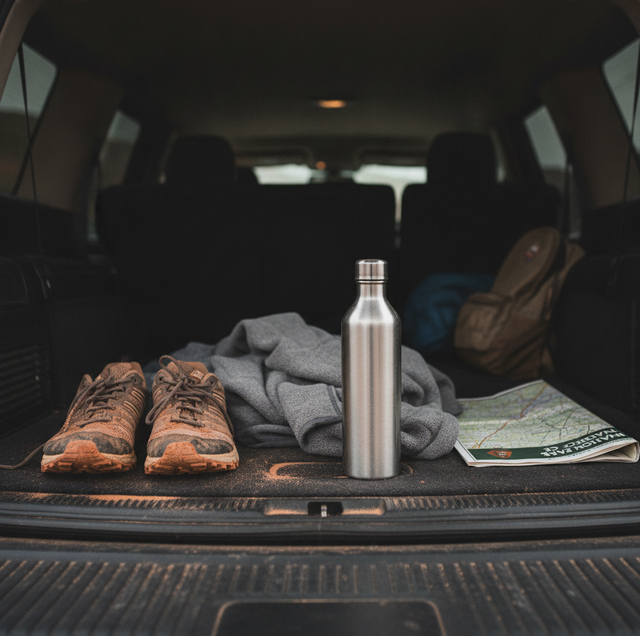
- Water, more than you think you need, since the air at 7,000 feet pulls moisture out of you fast
- A layer or two, a fleece or a light shell, even in summer, because the rim runs cooler than Sedona
- Sun protection, meaning a hat, sunglasses, and sunscreen, since shade is scarce right at the edge
- Closed, sturdy shoes with grip for the uneven paths along the rim
- Snacks and any medication you take during the day
- A camera or a well-charged phone, plus a spare battery if you shoot a lot
Frequently Asked Questions
On a standard day tour, you will be at the rim through the middle of the day, which is fine for a first look but flat for photographs. If light is your priority, sunrise and sunset cast the deepest colors and shadows across the buttes. Chasing sunrise means leaving Sedona in the dark, somewhere around 4 to 5 a.m., depending on the season, to reach an east-facing spot like Mather or Yaki Point in time. Sunset means a late finish and a two-hour drive home after dark, with Hopi Point and Yaki Point among the favored west-facing overlooks. A private tour can be built around either one, but pick a single goal and plan the whole day around it rather than trying to bracket both ends.
It can. The scenic climb out of Sedona on 89A packs a dozen or so tight switchbacks into a short stretch, and the constant turning bothers some passengers more than a straight highway would. If you are prone to motion sickness, sit up front, keep your eyes on the horizon, skip the heavy breakfast, and try ginger chews, which help some people. If that still sounds miserable, take the Williams approach instead, which trades the switchbacks for open interstate and reaches the canyon from the west. That same route is the standard backup in winter, when snow and ice can close the Oak Creek Canyon road entirely.
Enough to catch people off guard. Sedona sits around 4,500 feet, and the South Rim stands near 7,000, so the rim usually runs noticeably cooler, often 10 to 20 degrees, and the wind at the edge makes it feel colder still. In winter, snow can linger along the rim well after Sedona has thawed, and even a summer morning can start chilly before the sun climbs. Pack a layer you can peel off as the day warms, and do not judge the canyon by how warm it felt when you loaded the car.
A little, not a lot. The two maintained corridor trails, Bright Angel and South Kaibab, drop steeply from the rim, and a popular turnaround like Ooh Aah Point on the South Kaibab is within reach of a short out-and-back for reasonably fit walkers. Going deeper is a different kind of day, because the climb back out takes roughly twice as long as the way down, and rangers warn against trying to reach the river and return in one go. On a day tour, most visitors walk the flat Rim Trail and, at most, dip just below the edge, saving a real descent for a trip with more time.
The biggest practical gap is where the tour begins. Most shared motorcoach and van tours to the South Rim do not originate in Sedona at all; they load from Flagstaff, Williams, or as far off as Las Vegas, so a Sedona guest first has to reach that departure point and fit the day around a schedule set for someone else. A private tour starts at your own hotel or rental. Group size is the other deciding factor: for one or two people, a shared seat is the economical choice, but once you are a party of four or more, the math and the hassle tip toward a private vehicle you are not sharing with strangers. The small things differ too, like whether lunch is a fixed group stop or your own choice, and how much day-bag or gear room you get versus a packed coach with limited storage.
The park charges admission at the entrance station, but unlike some national parks, the South Rim does not use a timed-entry reservation to drive in, so you will not be turned away for lack of a booked slot. On a guided tour, the driver handles the entrance stop, and the free in-park shuttle buses that reach viewpoints like Hermits Rest are covered by entry, with no separate ticket to buy. The one thing worth locking in ahead is your ride out of Sedona, especially in the peak months when local private drivers book up early.
Ready to see the Grand Canyon without driving it yourself — book a private, door-to-door day tour from your Sedona hotel and let a local guide handle the route, the timing, and the overlooks. Western Express Shuttle Service and Tours serves Sedona, Flagstaff, Phoenix Sky Harbor, and northern Arizona's Verde Valley and Rim Country. Call (928) 202-4071.
