
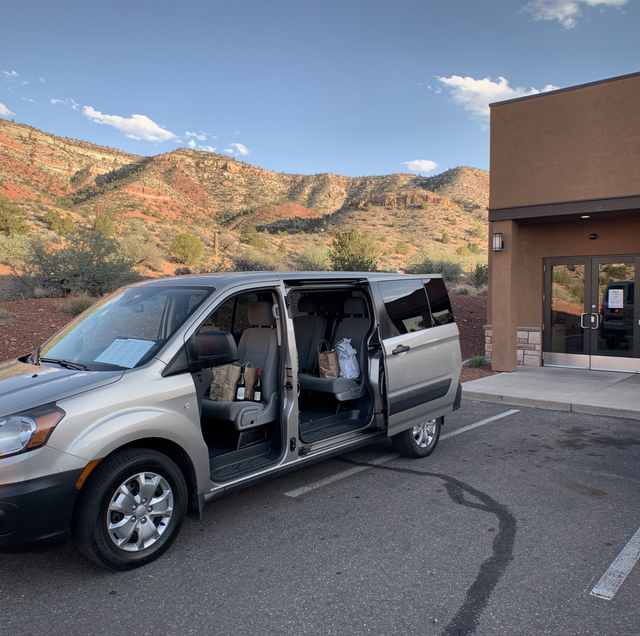
By the last tasting room of the day, the six of you who signed up for a relaxing afternoon are standing in a parking lot, quietly arguing over who feels sober enough to drive the curving road back. Nobody planned for that moment, and that is the planning failure. A group wine tour without a designated driver gets sequenced from the start, not improvised once the last glass is poured: who is coming, how many stops the day can hold, what each tasting room expects from a group, and how everyone gets home before anyone has poured a single glass.
Counting Heads Before You Count Wineries
The first number to settle is how many people need a seat and how much room the group's purchases will take up on the way back, and the count of tasting rooms comes after it. A pair or a trio fits into a sedan with space left over. A party larger than a sedan's passenger seats shifts the question toward a vehicle built for both bodies and bags, since the case of wine or the extra bottles bought along the way take up room the outbound trip never needed. Settling the vehicle size before the itinerary keeps the rest of the planning from running into a wall halfway through the day, when a case of wine and an extra rider suddenly will not both fit.
Whether that vehicle is one professional driver holding the whole group together, or several separate rides gathered for the same headcount, is a separate decision, and it depends on whether the group needs to travel and arrive as one unit rather than as a scatter of individual pickups.
Sizing the Day From the Stops Up
There is no fixed count of tasting rooms that fits a day; the number comes from how much each stop, the drive between stops, and any meal add up to when laid end to end. That total determines how the reservations are spaced and where the meal slot lands: a group that lingers over a full-pour flight and a walk-through needs its reservations spaced wider apart than a group that stops for a counter pour at each room and fits more rooms into the same block.
A day of several stops, with waiting time between them, is booked, with one driver assigned for the whole day.
Calling Ahead: Reservations and Group Policies at the Tasting Room
A tasting room built around a bar with a handful of seats treats a party of eight differently than a couple walking in off the street, and that difference shows up as a reservation requirement rather than a sign posted on the door. Ahead of the day, call or book online for every stop where the group is larger than a couple, and ask directly whether the room has a cap on party size, a private table option, or a rule about splitting one large group into two smaller seatings. Some rooms also set a minimum purchase to hold a table, a rule about outside food, or a cutoff time past which walk-ins are not seated at all. None of that is a step worth skipping. A room that cannot seat the full group at once may turn part of it away or split it into two staggered seatings nobody planned for. Every rider brings a photo ID, since a tasting room can ask anyone in the party for proof of age before it pours.
Building the Timeline Around Pickups and Meals
The pickup time is the anchor from which the rest of the day hangs. Work backward from the first reservation: pickup, plus drive time to that first stop, plus a buffer for loading a group and its bags, gives the hour to book. A meal belongs in the middle of that timeline rather than at either edge of it, both because a group that has been tasting since late morning is better served by food partway through the day than at the very end, and because a sit-down meal is a natural place to slow the pace before the afternoon stops. Building the meal into the schedule ahead of time, instead of deciding on the fly between stops, keeps the group from either skipping food to squeeze in one more room or discovering too late that the place it wanted is not seating walk-ins.
What the Driver Handles and What the Group Still Handles
A driver running the group for the day takes the driving itself off the table entirely: getting the vehicle to each stop, waiting through the tasting, and getting everyone to the next stop without anyone behind the wheel who has had a glass. What stays with the group is the plan the driver is executing. That includes which rooms to visit and in what order, how long to linger at a favorite stop, and flagging any change- a room running behind schedule, a stop the group wants to drop- to the driver as soon as it comes up rather than after the fact.
Alcohol dulls a person's ability to judge their own impairment, so the rider who feels least affected can still be unsafe on a curving road. Nobody in the group drives; the professional driver, who has not had a drink, handles every leg.
Paying for a tasting or a bottle at the counter remains the group's business at every stop; the driver's role ends at the door of each room and resumes the moment the group is back in the vehicle. Splitting those two jobs cleanly, driving on one side and drinking on the other, is the entire point of bringing a driver into a day built around tasting rooms.
Planning the Ride Home Before the Day Starts
The ride home is easy to leave unplanned right up until the last room closes and everyone is ready to leave, and that is exactly the point where early planning pays off. If the day is run on a single reserved vehicle and driver, the ride home is already included in the booking, and nobody has to arrange anything once the last glass is poured. If the plan instead depends on finding a car after the fact, that search plays out very differently depending on where the day ends. Pulling up a ride in a spot with steady rideshare coverage can be a short wait. Doing the same from a small town or a rural stretch between tasting rooms can mean a long one, or no car showing up at all, right when the group is tired and ready to be done.
That gap is worth building into the plan itself, not discovering at the last tasting room of the day with a group standing in the lot. A pre-arranged ride removes the question entirely, whatever the coverage looks like where the day happens to end.
Frequently Asked Questions
Book as soon as the day itself is set. Some tasting rooms cap the number of large parties they seat in a day, so a date can be booked out for large groups while walk-in space for a couple or two is still available.
Yes. Anyone who wants to sit a stop out can wait in the vehicle with the driver rather than standing around at the venue, since the vehicle is already staged there for the length of that stop anyway. It works best when the group flags it before arriving, so the driver knows to expect a shorter walk-through for part of the party rather than the full group heading in together.
On a warm day, a closed vehicle heats up quickly enough to affect the wine left inside, so flag it to the driver. Purchases can ride in a shaded or climate-controlled part of the cabin instead of a sun-facing cargo area, which keeps the afternoon's heat off a case that just got loaded.
Ask when booking. A cooler for a picnic stop can ride in the vehicle and takes up cargo space the same way a case of wine does, so it goes into the space plan alongside the purchases.
An added rider flagged before the day can be matched to a vehicle with a seat for them; a same-morning addition depends entirely on whether the booked vehicle has an open seat left. Locking in the final headcount the day before, rather than the morning of, avoids turning a late addition into a scramble.
Yes, but it is a change to flag when booking, not a same-day request. A driver working from a fixed pickup-and-drop-off plan needs the final address in advance to route the return leg correctly, rather than working it out on the fly once the group is ready to leave the last stop.
Planning a group wine day with no one volunteering to stay sober? Book one private vehicle and driver for the whole outing and skip the after-tasting scramble for a ride. Western Express Shuttle Service and Tours serves Sedona, Flagstaff, Phoenix Sky Harbor, and northern Arizona's Verde Valley and Rim Country. Call (928) 202-4071.