
Stranded on I-17? How Roadside Passenger Pickup Works
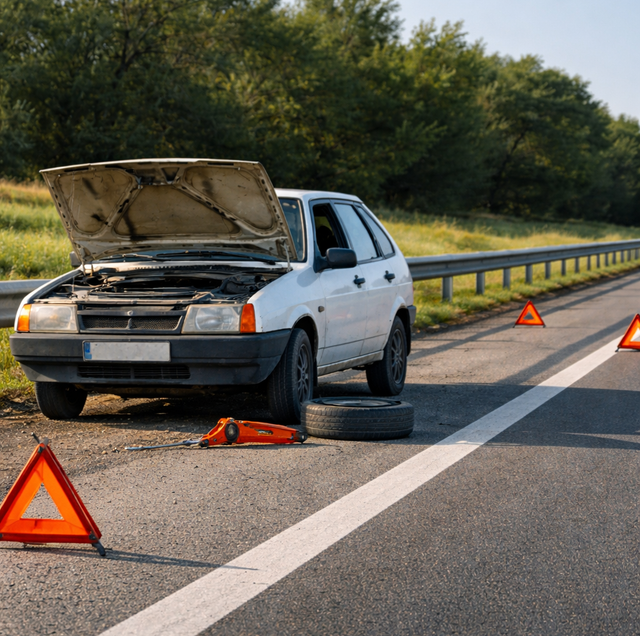
The temperature light on your dash blinks on somewhere past Sunset Point, and by the time you coast onto the shoulder, the engine is ticking, and the nearest town is a name on a sign twenty miles back. I-17 does this. The stretch between the Phoenix basin and Flagstaff climbs several thousand feet through country with long empty gaps, thin cell coverage in the canyons, and exits spaced far apart. If that is where you are right now, the steps below are the order to work through, starting with the ones that keep you safe.
What to Do First When You Break Down on I-17
Handle these in sequence. The first three are about not getting hit; the rest are about getting a ride.
- Get out of the travel lane: Steer for the right shoulder, and if you can still roll, aim for the widest, flattest spot you can reach: a pull-out, a gore area at an exit ramp, or past the end of a guardrail. On the grades, coasting a little farther to a better spot beats stopping in a narrow, curved section where traffic comes around a bend fast.
- Turn on your hazard lights: Do it the moment you leave the lane, day or night. If you carry reflective triangles or flares, set them well behind the car so a driver coming uphill has time to move over.
- Get everyone out on the far side: People should exit away from traffic and wait behind the guardrail or up the embankment, not sitting in the car in the breakdown lane and not standing between the car and the passing lane. A stopped vehicle on a 75 mph interstate is the real danger, so put distance and a barrier between your group and the lane.
- Fix your location before you make a call: Look for the small green mileposts along the shoulder and read the number, and note whether you are northbound or southbound, because I-17 is a divided highway and the two directions can be a long detour apart. Add the last exit you passed or the next one ahead (Sunset Point, Bloody Basin, Cordes Junction, Camp Verde, Stoneman Lake) and any landmark. That milepost plus direction is what turns "somewhere on I-17" into a spot a driver can reach.
- Call for a passenger pickup, and arrange a tow separately: These are two different calls. A roadside passenger pickup sends a vehicle to carry you, your passengers, and your luggage onward to where you were headed. Your car leaves on a tow truck, which you book through your own roadside plan, auto club, or a local towing company. Line up both so your ride out and your car's ride to a shop are each covered.
Only after you are safely off the lane and know your milepost is it worth lifting the hood, checking a tire, or deciding whether the car moves again. Do that from the protected side of the guardrail if the shoulder is tight, and skip it entirely in rain, snow, or heavy traffic where standing at the car is the bigger risk.
Roadside Passenger Pickup Is Not a Tow Truck
This is the part travelers most often get backward, so it is worth being plain about. A roadside passenger pickup moves people, not machinery. A driver comes to your location on I-17, loads your bags into a clean sedan, SUV, or van, and takes you and everyone with you to your actual destination: your hotel in Sedona, a home in the Verde Valley, your terminal at Sky Harbor if you have a flight to catch, or a shop in Flagstaff if that is where the car is going.
What a passenger pickup does not do is hook up your vehicle. It has no winch, no flatbed, and no mechanic. The car stays with the tow company you arrange, and the two run on parallel tracks: the tow driver deals with the vehicle, the pickup driver deals with you. Many people wait with the car until the tow arrives, follow it to the shop, then continue their trip in the pickup instead of being stuck at a repair counter miles from where they need to be. Splitting it this way keeps a broken-down car from turning into a canceled trip or a missed flight.
Staying Safe While You Wait for the Ride
Once the calls are made, the waiting is where good decisions matter most. Stay out of the car if it is anywhere near the travel lane; a vehicle parked on the shoulder gets struck often enough that behind the guardrail is the safer place to stand. Keep your phone charged for the callback, since the driver may need to confirm your milepost or check traffic before choosing which side to approach from.
If you can safely reach an exit on foot or by nursing the car there, a lit gas station or rest area is a far better pickup point than a blind curve on the interstate, and it gives the driver a fixed address instead of a moving guess. Tell dispatch you are moving there so the pickup meets you at the exit. At night, a divided mountain highway is darker and emptier than most drivers expect, so a flashlight, reflective clothing, and staying well off the asphalt all make you easier to find and harder to hit.
Why This Corridor Strands People in Every Season
I-17 breaks cars year-round, and the reasons flip with the calendar, which is why a plan that only accounts for one season leaves you exposed in the other. In the warm months, the long northbound climb runs engines and transmissions hard in high heat, cooling systems boil over, and tires that were already worn let go on hot pavement. Afternoon monsoon storms can drop heavy rain and cut visibility on the grades with little warning. In the cold months, the same climb carries snow and ice near Flagstaff and the Rim while Phoenix stays dry, so a car that is fine on the desert floor can slide or stall in conditions it never met below. Elevation is the constant underneath both: you cross from around 1,100 feet in the basin to roughly 7,000 feet near Flagstaff, and cars feel that change as much as people do.
None of that is a reason to fear the drive. It is a reason to save a number before you need it. Breakdowns rarely happen at a convenient exit; they happen at milepost 262 with a phone at one bar. Knowing in advance that your ride out and your tow are two separate calls, and having a way to reach both, is what turns a bad afternoon on the interstate into an inconvenience instead of an ordeal.
Frequently Asked Questions
Just you and your passengers. A passenger pickup is not a tow service and cannot move the vehicle, so the car is a separate arrangement. Call your insurer's roadside line, an auto club like AAA, or a local towing company for the tow; on I-17, the Arizona Department of Public Safety or an ADOT crew may also come by a disabled vehicle. A common approach is to wait with the car until the tow arrives, send it to a Flagstaff or Camp Verde shop, and ride out in the pickup so you are not stranded at the shop yourself.
As much as the vehicle is sized to hold your group, which is why it helps to describe your load when you call, not just your head count. A couple with two suitcases fits a sedan; a family with ski bags, coolers, or camping gear needs an SUV or van so nothing gets left on the shoulder. Mention oversized or awkward items (bikes, golf clubs, a pet carrier, a child's car seat) up front so the right vehicle is dispatched the first time rather than a second trip being needed.
Usually, yes, within the seating of the vehicle sent. If your party is larger than one car holds, or you have a van's worth of people plus a pile of luggage, say so when you call so the dispatcher can match a van or send more than one vehicle. This matters most for family road trips and small tour groups whose single broken-down vehicle was carrying everyone, since the pickup has to replace all of that seating at once.
Around-the-clock dispatch means a 2 a.m. breakdown is handled like a midday one, because I-17 empties out after dark and a stalled car far from an exit is a lonelier place at night. The difference at night is location: with fewer landmarks visible, read the green milepost and your direction carefully, and if you can reach a lit exit, wait there. Keep your hazards and dome light usable so the driver can pick your car out of the dark.
By your milepost and direction, backed up by the nearest exit and any landmark you give. Because I-17 is divided, northbound and southbound at the same milepost can be a real detour apart, so stating the direction is as important as the number. If your phone can share a live location or drop a pin, that helps confirm the spot; if coverage is thin in a canyon, the milepost is the reliable fallback. Staying put once you have given your location, rather than walking on, keeps you where the driver expects to find you.
Outside and behind a barrier, in almost every case, when the car is close to live traffic. Vehicles stopped on interstate shoulders are hit often enough that the car itself is the hazard, so get everyone up the embankment or behind the guardrail and away from the lane. The exception is severe weather or an unsafe embankment, where sheltering briefly may be the lesser risk; even then, keep everyone on the side away from traffic and move to a guardrail or exit as soon as it is safe.
Getting Back on Your Way
A breakdown on I-17 is mostly a logistics problem once you are safely off the road: the car has one path forward, and you have another. Keep them separate in your head from the first minute. Get clear of the lane, mark your milepost and direction, call for a passenger pickup to carry you and your bags onward, and let a tow company take the car to a shop. Handled in that order, a stalled engine in the high country stops being the thing that ends your trip and becomes a two-hour detour you will be telling people about later.
Save the number before you drive I-17, and if you end up stranded, call for a roadside passenger pickup to get you and your luggage to your destination while your car is towed. Western Express Shuttle Service and Tours serves Sedona, Flagstaff, Phoenix Sky Harbor, and northern Arizona's Verde Valley and Rim Country. Call (928) 202-4071.
